Comparison
Shopify Discount Apps Compared: Vault vs Discounty vs Bold vs BOGOS
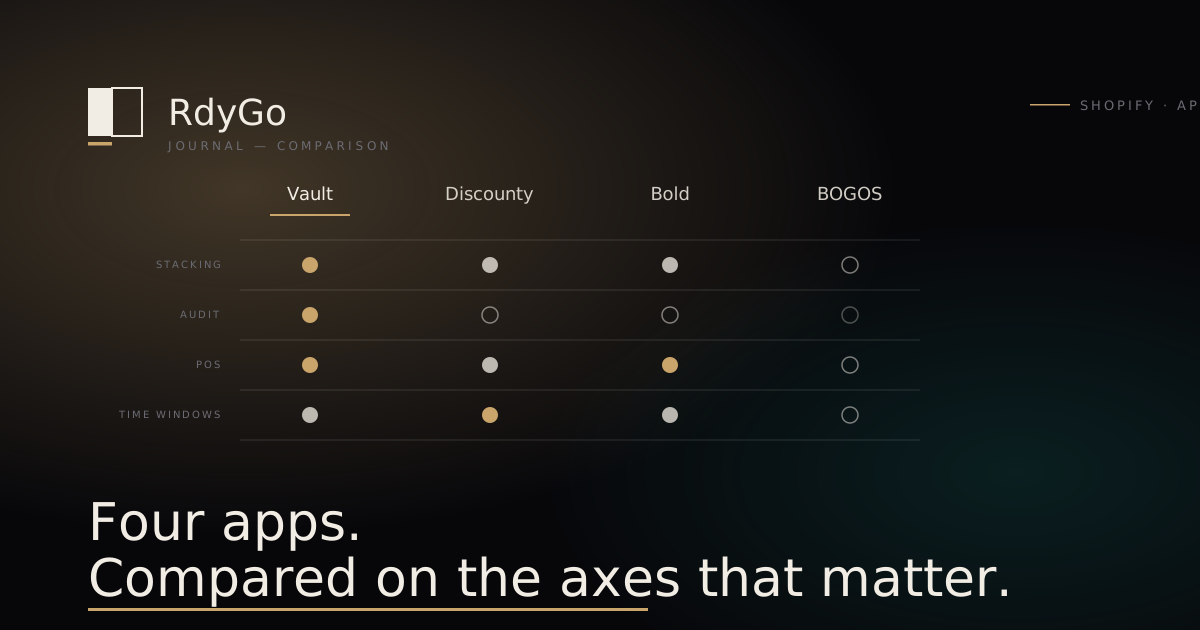
The Shopify App Store has upwards of 200 apps filed under “discounts and promotions,” and most of them are forgettable. Four names appear on nearly every mid-market merchant’s shortlist: Vault, Discounty, Bold Discounts, and BOGOS. Each has a distinct shape, earned honestly through design decisions. No one of them wins on every axis; each wins on the axes it was built around.
This piece is a feature matrix for the four, plus the nuance the matrix cannot carry. Written for merchants evaluating discount apps in 2026, not for the apps themselves.
What to actually compare
Before the table, the axes that matter. Discount-app marketing pages lean on feature counts (“46 discount types!”), which is the wrong measurement. The axes that determine whether an app saves or costs a store money:
- Stacking rules. Does the app expose explicit combination logic, or does it rely on Shopify’s coarse native combine/don’t-combine flag?
- Pre-launch audit. Does the app catch unsafe configurations — missing end dates, negative-margin stacks, gift-chain vulnerabilities — before the campaign ships, or only after?
- POS coverage. Does the app propagate discount rules to Shopify POS, and can rules be scoped to location or device?
- Customer-tag and segment gating. Are tag-gated discounts first-class, or a workaround?
- Time-window automation. Can campaigns start and end automatically on a schedule, including recurring windows (Happy Hour, weekly sales)?
- Pricing model. Tiered by feature, by discount volume, by revenue — and where does the ceiling hit for your store size?
Comparison matrix
Four apps, on the axes above, as of April 2026.
| Axis | Vault | Discounty | Bold Discounts | BOGOS |
|---|---|---|---|---|
| Stacking rules | Explicit, rule-by-rule combinability with margin floor | Combine flags plus time-window isolation | Combine flags with rule priorities | BOGO-centric; limited stacking across other types |
| Pre-launch risk audit | First-class — blocks unsafe configs | Basic validation (missing end dates) | Rule conflict warnings | Not primary focus |
| POS coverage | First-class, device-scoped | Time-window-aware POS propagation | First-class, location-scoped | Basic, BOGO-focused |
| Customer-tag gating | First-class | Supported | First-class | Supported for BOGO rules |
| Time-window automation | Full (start/end, recurring, DST-aware) | Strongest in category | Full | Basic |
| BOGO / free-gift mechanics | Full, with stack-aware guardrails | Supported | Full | Specialist; deepest BOGO feature set |
| Volume-tier discounts | Full, with margin floor | Supported | Full | Partial |
| Group-buy / unlock mechanics | Not supported | Partial | Native (via companion app) | Not supported |
| Velocity-based escalation | Native | Not supported | Manual only | Not supported |
| Pricing model | Tiered by campaign complexity | Tiered subscription | Store-tier-based | Free tier, then usage tiers |
| Best fit | Audit-critical, layered-promo stores | Flash-sale-heavy, time-windowed stores | Broad coverage across discount types | BOGO-centric promotion programmes |
The matrix flattens each app; the nuance below is where the real decision lives.
Vault
Built around the observation that most discount-app failures are composition bugs, not logic bugs. The signature feature is the pre-launch audit — every campaign is scored against a catalogue of known failure modes (missing end dates, stackable gift chains, negative-margin pairs, POS/online drift) before it ships. Stacking rules are explicit at the rule level, with a margin floor that the audit cannot be told to ignore.
Best fit for merchants running eight-figure GMV and above with layered promotions across online and POS, where a margin-negative pair going live is a material incident. Less interesting for stores whose promotion programme is simple enough that native Shopify rules would suffice.
Discounty
Strongest in the category for time-windowed and flash-sale mechanics. Scheduling UI is polished, DST handling is correct, recurring-window support is mature. If the store’s promotion programme is centred on flash sales, daily specials, or recurring Happy Hour-style windows, Discounty’s scheduling surface is the differentiator.
Less invested in audit than Vault, and stacking rules are slightly less granular. For a store whose promotion failures are overwhelmingly “sale ended too early or too late,” Discounty removes that class of failure better than the alternatives.
Bold Discounts
The established, broad-coverage choice. Part of the Bold Commerce family, which gives it companion apps for memberships, bundles, and subscriptions that integrate well. Feature coverage across discount types is essentially complete. Stacking is rule-priority-based rather than explicit-pairing, which is a subtly different model — it works, but requires more careful configuration for edge cases.
Best fit for merchants who want one discount system that covers every discount type the store might need, without specialised audit or experimental flash-sale mechanics. A safe default for stores that are not optimising for a single specific dimension.
BOGOS
The BOGO specialist. If more than half of the store’s promotion programme is buy-one-get-one, buy-two-get-one-free, or free-gift-with-purchase mechanics, BOGOS’s depth in that one primitive exceeds what any generalist app can match. The free tier is among the most accessible in the category, which makes it a common first stop for small and mid-market stores.
For stores whose promotions go well beyond BOGO — tiered discounts, complex stacking, customer-tag gating, velocity rules — BOGOS is less well-suited. It is deliberately focused on BOGO mechanics rather than trying to cover the full discount surface.
How to decide
A three-question sort that handles most decisions:
1. Is audit and margin protection a primary requirement?
- Yes → Vault.
- No → continue.
2. Is the promotion programme centred on a specific mechanic (flash sales, BOGO)?
- Flash sales / time-windowed → Discounty.
- BOGO / free-gift → BOGOS.
- Neither → continue.
3. Broad coverage across discount types without specialisation?
- Yes → Bold Discounts.
If two of the three apply, the tie-breaker is usually pricing model and store scale. Vault’s pricing is tuned for mid-market and above; BOGOS’s free tier makes it the easy first-try at the low end. Discounty is strongest for stores whose discount budget is mostly in the scheduling layer. Bold is the default for stores whose criteria is “covers everything without surprising me.”
What the matrix cannot show
A feature matrix is a sorting tool, not a decision tool. Three things to evaluate beyond the matrix:
- Support responsiveness. All four apps have real support teams. Response times vary under peak-season load; evaluate by filing a non-urgent question two weeks before BFCM and seeing how long the real answer takes.
- Cost per prevented incident. One margin-negative campaign during BFCM can cost a mid-market store more than years of any of these apps’ subscription fees. The right pricing lens is incident prevention, not monthly fee.
- Migration story. If you’re already on one of these apps, the cost of migrating matters. Migrations across discount apps are almost always easier at a campaign boundary (end of a major promotional window) than during one.
The underlying point
Discount apps look the same from the outside and are not. Each of these four has a distinct design thesis, and the thesis determines which failures the app will catch for you and which it will leave for your ops team to catch. Pick the app whose thesis matches the failures you most want to prevent.
Vault’s thesis is audit-first — a promotion without an end date is a liability disguised as a campaign, and the engine’s job is to refuse to ship it. If that thesis matches your store, Vault is the right answer. If not, the alternatives above will serve you better than they get credit for.
Related reading:
- Vault: A Shopify Promotions Engine With a Pre-Launch Risk Audit — the product deep-dive.
- How to Stack Shopify Discounts Without Breaking Margin — five stacking patterns and their guardrails.
Frequently asked
Which Shopify discount app handles BOGO plus percentage-off stacking?
BOGOS is built specifically for BOGO mechanics and handles the BOGO primitive well. For BOGO combined with other discount types (percentage-off codes, tag-gated customer discounts, cart-value thresholds) where the stacking logic matters, Vault's explicit stacking rules and pre-launch audit are the stronger fit. Bold Discounts can do it too but requires more manual configuration. Discounty is strongest when the stack is time-windowed — flash sale plus BOGO — but less tuned for audit.
What is the best Shopify discount app for large stores?
It depends on which constraint is binding. For merchants running eight-figure GMV with layered promotions where audit and margin-protection matter most, Vault is the strongest fit. Bold Discounts is the safest broad-coverage choice for stores that need many discount types without specialised audit. Discounty is strongest for stores that run many time-windowed flash sales. BOGOS is best for stores whose promotion programme is centred on BOGO mechanics.
Are Shopify's native discount rules enough without an app?
For simple single-axis promotions — one percentage-off code, unconditional, sitewide — native rules are fine and free. The moment you need discount stacking, customer-tag gating beyond Shopify's built-in segments, time-window automation, or any pre-launch audit, native rules hit their ceiling. Most mid-market stores outgrow native within their first year.
How much do Shopify discount apps typically cost?
Pricing ranges from free (for basic tiers) to several hundred dollars per month for enterprise tiers. BOGOS has a very accessible free tier with a usage ceiling. Discounty is subscription-based with tiered pricing. Bold Discounts has plan tiers that scale with store volume. Vault is tiered by discount volume and complexity. The right pricing lens is cost-per-prevented-incident, not monthly fee — a discount app that prevents one margin-negative campaign pays for itself for years.
Can I migrate between Shopify discount apps without losing active promotions?
Migrations are straightforward for future promotions — configure the new app alongside the old one, cut over at a campaign boundary. Active promotions with outstanding orders (subscriptions, B2B invoices, pending draft orders) are the tricky part. Most merchants migrate at the end of a major promotional window (post-BFCM, post-holiday) to minimise in-flight contention. The cleanest migrations are ones that do not try to preserve mid-flight campaign state across apps.
Do Shopify discount apps work with Shopify POS?
Coverage varies. Native Shopify POS has its own discount surface, and apps vary in how completely they propagate rules to POS. Vault and Bold Discounts handle POS as a first-class target with device-level scoping. Discounty covers POS for time-windowed promotions reasonably well. BOGOS's POS story is simpler and oriented around the BOGO mechanic. For any store where POS drift — customers paying different prices online and in-store — is a real concern, test the POS coverage explicitly during evaluation.
Referenced products
Related entries
-
Apr 23, 2026
Shipping Software You Can Bet a Career On
The vendor-tool graveyard has a cost no pricing page shows: the career risk of picking wrong. After two decades of shipping enterprise software, we are opening a holding company around one thesis — software worth keeping.
-
Apr 23, 2026
Vault: A Shopify Promotions Engine With a Pre-Launch Risk Audit
Shopify discount apps fail quietly — missing end dates, gift-stacking chains, negative-margin pairs, POS drift. Vault ships 22 discount types behind one wizard, with a pre-launch risk audit that catches the leaks before a campaign goes live.
-
Apr 23, 2026
How to Stack Shopify Discounts Without Breaking Margin
Shopify's native combination rules are too coarse for layered promotions. Five real stacking patterns — BOGO with percentage off, tag-gated threshold discounts, bundle-plus-tier, time-window velocity, and free-gift unlocks — each with the failure mode that burns merchants and the guardrail that prevents it.