How-to
How to Stack Shopify Discounts Without Breaking Margin
Shopify’s native discount combination engine solves the easy half of stacking — can this code combine with that code? — and leaves the hard half to whoever ships the promotion. The hard half is where the money goes.
Most discount stacking bugs ship in a specific pattern. A merchant composes two rules, each of which is reasonable. Each passes individual review. Native combination is set to allow. The stack works fine for 90% of carts. In the remaining 10%, the combined stack hits a margin corner nobody walked through at compose time.
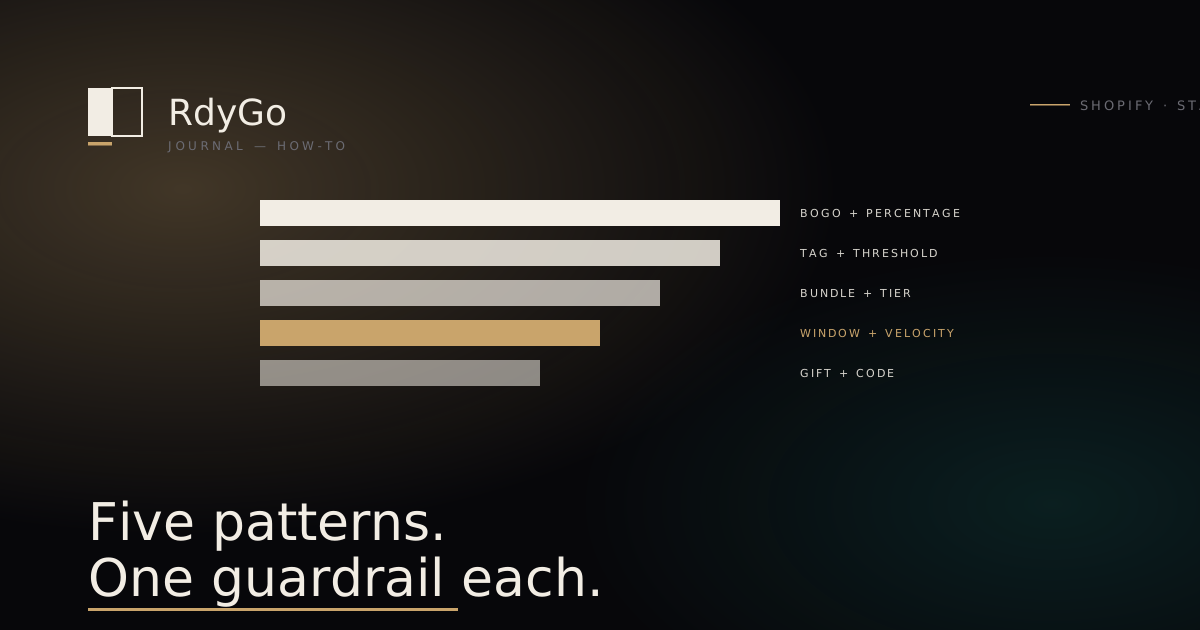
Below are five stacking patterns we have seen break in production, each with the failure mode and a guardrail that prevents it. None of this is theoretical; all five have cost real merchants real money.
Pattern 1 — BOGO plus percentage off
Setup. BOGO on shoes (buy one pair, get the second free). Sitewide 20% off code available to all customers. Both rules are set to combinable.
Failure mode. A customer buys two pairs — the second one is free under BOGO. The sitewide 20% applies to the post-BOGO cart total, which is just the cost of the first pair. But depending on the discount app, the 20% can also apply to each line separately, meaning the “free” second pair gets a 20% discount against zero, which does nothing — or worse, if the app treats BOGO as a fixed dollar amount off the second line, the 20% compounds on the reduced line, and the merchant ends up paying the customer.
We have seen the latter ship. It cost a footwear brand roughly $14k before the ops team noticed the pattern in the order export.
Guardrail. Run a pre-launch simulation across 20 representative cart compositions — BOGO-eligible carts of 2, 3, 4, 5, and 6 units, each with and without the code applied. The simulation needs to output the blended margin, not the discount percentage. If any simulated cart has a blended margin below the merchant’s configured floor, the stack does not ship without an explicit override.
Pattern 2 — Tag-gated discount plus cart-value threshold
Setup. VIP customers (tag-gated) get 15% off sitewide. Free shipping is unlocked at $100 cart value. Marketing expects VIPs to hit the $100 threshold after the 15% is applied; ops configured the threshold against the pre-discount cart value.
Failure mode. A VIP customer builds a cart totalling $99 after the 15% is applied (pre-discount: $116.47). They expect free shipping. The cart engine evaluates the threshold against the post-discount value, finds $99 < $100, and charges $9.50 for shipping. The customer abandons.
The mirror failure mode: threshold is evaluated pre-discount, so a non-VIP customer with a $100 cart gets free shipping, but a VIP customer who started at $110 and came down to $93.50 after the 15% does not. Either way, someone is confused.
Guardrail. Pick one — pre-discount or post-discount — and document it explicitly in the discount rules. Whichever you pick, the threshold value must be chosen against that basis. If marketing wants “effective cart value $100+” the threshold lives against the post-discount basis; if they want “sticker price $100+” it lives against the pre-discount basis. There is no right answer; there is only the answer you committed to.
Pattern 3 — Bundle plus volume tier
Setup. Product bundle (three items for a fixed $89, saving $15 off the à la carte total). Tiered volume discount on bundles: buy 2 bundles for 5% off the bundles, 3 bundles for 10%.
Failure mode. A wholesale-adjacent customer buys four bundles. The tiered discount steps jump per bundle-count band. If the tier table is poorly configured, the marginal “fourth bundle” can cost less than a single bundle at the lowest tier — because the tier boundary pushed the blended rate into unsweet territory. Separately: if the bundle pricing itself is promotional (say, the bundle is already a 15% saving over à la carte), the tier applies on top, and the combined discount can compound past the intended ceiling.
Guardrail. Define a margin floor per product, not per discount. The floor is the minimum unit margin any component of the cart is allowed to reach after all discounts apply. When the tier + bundle combination would take a unit margin below the floor, the tier caps at the last safe boundary. This is the same principle as VaR in financial risk — your downside is bounded by design, not by how cleverly the promotion was composed.
Pattern 4 — Time-window plus velocity escalation
Setup. A Happy Hour discount (15% off, weekdays 4–6pm). A velocity escalation rule: if more than 100 units of the discounted SKU sell in an hour, the depth increases to 20%.
Failure mode. The velocity rule fires at 4:45pm on a day when the brand had a social media boost. Depth jumps from 15% to 20% with 15 minutes left in the window. Customers who had already paid at 15% now see a better price, and some share the screenshot. The brand either eats the refund requests or absorbs the trust hit. Separately: the velocity rule ignores that the window is about to close, so the escalation window kept the 20% rate running into inventory the merchant wanted to preserve for the next day.
Guardrail. Velocity escalation rules should have a window-awareness clause: “escalate only if at least 30 minutes remain in the time window,” or “do not escalate within the last 20% of a window.” And they should have an absolute cap on total escalated volume — past the cap, the depth reverts even if the rate condition still holds. Time-windowed velocity rules without a minimum-remaining-window clause will misfire at the tail; it is the single most common velocity bug.
Pattern 5 — Free-gift unlock plus promo code
Setup. A free gift unlocks when the cart crosses $150. A seasonal 10% code is available sitewide.
Failure mode. A customer builds a $165 cart pre-discount, applies the 10% code, and the cart drops to $148.50. The gift-unlock condition is evaluated against the post-discount cart, the condition fails, the gift does not add. The customer, having seen the gift-unlock banner before applying the code, is confused; support opens a ticket. The merchant either honours the gift manually or loses the customer.
Or the reverse: the gift-unlock condition is evaluated pre-discount, so the gift adds, and the 10% applies including the gift’s zero-priced line. Depending on how the discount app treats the zero line, the customer might see an unexpected reduction — or worse, if the gift has a non-zero internal cost and the promo applies to the line’s internal value, the merchant pays out against their own free gift.
Guardrail. Free-gift unlocks should be evaluated at a fixed point in the cart pipeline — always pre-discount or always post-discount — and the pricing logic must treat the unlocked gift as a separate line that is not eligible for other discounts. Both of these are configuration choices that need to be made explicitly. The failure is almost always in what “eligible” means for the gift line when other discounts apply.
What the five patterns have in common
Every one of these failures is a composition bug, not a logic bug in any individual rule. That is why they are hard to catch in review — the code that implements each individual rule is correct. The composition is where the invariant breaks.
The mechanical fix is a pre-launch audit layer that evaluates every combinable pair (and triple) against a representative basket of carts, with a margin floor that the audit cannot be told to ignore. Vault ships this as its default behaviour — the audit is the product, not a feature bolted on top.
The organisational fix is simpler and harder. Every layered promotion ships with a one-page risk review: what is the expected discount depth, what is the floor, what are the representative cart compositions we tested against, what stacking pairs are allowed and which are explicitly disallowed. If the review does not exist, the promotion does not ship.
The review is not hard to write. It is easy to skip under deadline pressure. The audit layer’s job is to be the thing that does not get skipped.
Related reading:
- Vault: A Shopify Promotions Engine With a Pre-Launch Risk Audit — the discount types and the audit layer.
- Shopify Discount Apps Compared: Vault vs Discounty vs Bold vs BOGOS — feature matrix across the dominant discount apps.
Frequently asked
Can you stack BOGO with percentage off in Shopify?
Yes, but not with Shopify's native discount engine alone — native combination is allow/disallow at the rule level and does not express the guardrails you usually need. You need either custom logic via Shopify Functions or a discount app that exposes explicit stacking rules, including a margin floor that prevents the stack from going below a configured threshold.
What is the most common Shopify discount stacking failure?
The stackable gift chain. BOGO plus percentage off plus a free-gift unlock, in combination, can produce carts where the total paid is less than the cost of goods. It fails silently during peak season because each individual rule looks reasonable in isolation. The guardrail is a pre-launch margin simulation across representative cart compositions.
How do customer tags interact with discount stacking?
Customer tags gate eligibility, not combinability. A VIP-only 20% discount that happens to be combinable with a sitewide 10% code will stack on VIP customers and not on everyone else, which is usually not what marketing intended. Always check tag-scoped discounts against the combinable-rules matrix, and treat the tag as a primary axis in the stacking decision.
Does Shopify POS honour the same stacking rules as online?
Not always. Native Shopify POS has a narrower discount combination surface than the online checkout, and third-party apps may not propagate stacking rules to POS at all. The failure mode is POS/online drift — customers pay one price online and a different price in-store. Any stacking design that ships to POS needs an explicit POS-side test.
Is there a way to cap discount depth across stacks?
Yes, by defining a margin floor — the minimum blended margin the cart is allowed to hit after all discounts apply. Some discount apps enforce this natively; otherwise Shopify Functions can implement it as a final pass on the cart. The cost of skipping this guardrail in peak season is typically the margin on the single highest-volume day of the year.
Referenced products
Related entries
-
Apr 23, 2026
Shipping Software You Can Bet a Career On
The vendor-tool graveyard has a cost no pricing page shows: the career risk of picking wrong. After two decades of shipping enterprise software, we are opening a holding company around one thesis — software worth keeping.
-
Apr 23, 2026
Vault: A Shopify Promotions Engine With a Pre-Launch Risk Audit
Shopify discount apps fail quietly — missing end dates, gift-stacking chains, negative-margin pairs, POS drift. Vault ships 22 discount types behind one wizard, with a pre-launch risk audit that catches the leaks before a campaign goes live.
-
Apr 23, 2026
Shopify Discount Apps Compared: Vault vs Discounty vs Bold vs BOGOS
Four names dominate the Shopify App Store for discount and promotion apps. Compare Vault, Discounty, Bold Discounts, and BOGOS on stacking rules, pre-launch audit, POS handling, customer-tag gating, and pricing. A feature matrix plus the trade-offs a matrix can't carry.